Interviews ·
8 min read


This summer we closed our seventh Venture Program. Eight ventures from seven countries, ten weeks of work, ending with Pitch Day in Zürich. Our Investment Committee had a difficult decision, and eventually made two. The first was Z Bio. The second is the one we are announcing today.
Rhea Soil Health, co-founded by Priscilla Wakarera and Soinato Leboo, is now part of the Brainforest portfolio.
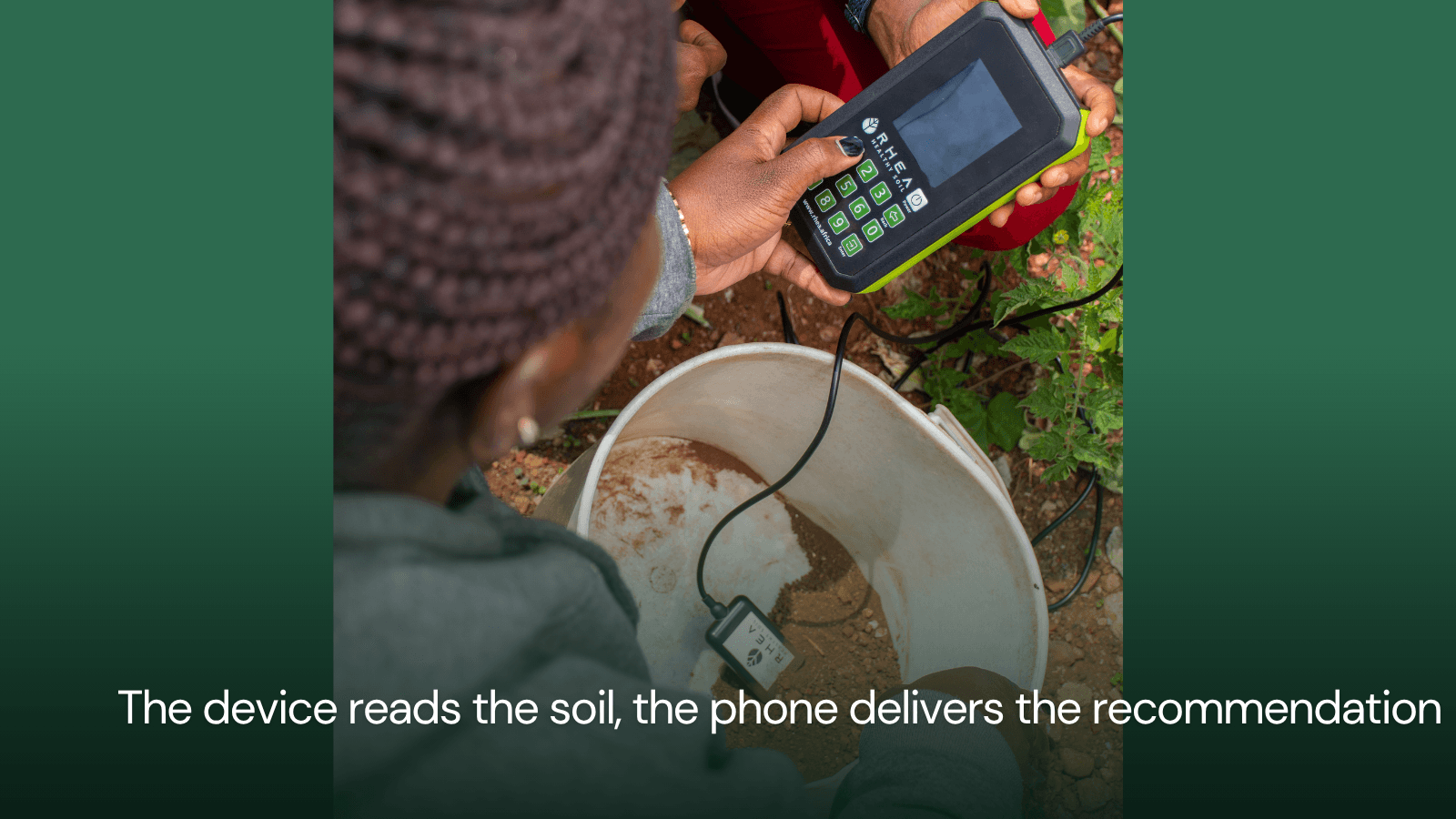
Rhea gives smallholder farmers something they have long been denied: an answer about their own soil while there is still time to act on it. A farmer books a test, an agent comes to the farm, and within fifteen minutes the results arrive on the farmer’s phone. A laboratory test takes around fourteen days, by which point the planting window has usually closed.
The device travels with a network of trained agronomist agents, so farmers do not need to own the technology or travel to reach it. Today Rhea works with 215 agents across 16 of Kenya’s 47 counties, and has reached 30,000 farmers. Devices have been sold in Tanzania since July 2024.
What drew us to Rhea is where the story begins. This is a company founded by a soil research scientist, in response to the decline of biodiversity at the soil microbial level. The living layer underneath a field is where an ecosystem starts, and most of the time it is invisible. It is also a women-led team building infrastructure that creates dignified rural work.
We sat down with both founders to hear the whole story.

Co-founders Soinato (l) and Priscilla (r)
It started in a lab, with a problem nobody could solve
Priscilla is a soil research scientist. During her research, she could not get timely access to soil analysis data when she actually needed it. Then she discovered that smallholder farmers were hitting exactly the same wall, only with far more at stake.
That realisation changed the direction of her career.
“I started to feel that without solving the problem of soil data access at the rural level, many of the other soil fertility measures we were researching were essentially a band-aid on a much bigger problem.”
So she set out to take the science out of the lab and rebuild it around how farmers actually work. Low cost, accessible, and above all immediately useful.
Soinato joined as co-founder immediately after, and she is candid that soil testing was not on her radar before she met Priscilla. She had done agricultural research, but this was new.
“When she explained that soil health and access to soil data was key to unlocking an increase in crop productivity, environmental conservation, and economic growth, something clicked inside me and instantly made me want to work with her on Rhea.”
What actually happens on a farm
The process is deliberately simple. A farmer books a test. An agent in their area comes to the farm, takes the sample and runs the analysis on the spot. For a basic analysis, the results and recommendations arrive directly on the farmer’s phone.
Those recommendations follow the 4R principles of agronomy: the right source, at the right rate, at the right time, in the right place. Fertiliser, pH adjustment, organic matter. What to apply, how much, when and where.
If a farmer needs something more detailed, including soil pathology testing, the sample can be packaged and sent on to a laboratory.
Why the fourteen days matter so much
This is the part that took us a moment to fully appreciate. The problem with a two-week wait is not really the waiting. It is that farming does not wait.
Farmers plant as soon as the first rains arrive, because missing the planting window means losing the season. That same moment is often when seasonal financing comes through, when input subsidies are available, and when fertiliser is being sold at a good price. A soil test that arrives fourteen days later arrives after all of it.
“When soil test results take too long, farmers can reach a point where they have to plant anyway because the rains have arrived. They end up abandoning the test results and proceeding with the inputs they already planned to use.”
The consequence is quiet but serious. Deficiencies that should have been corrected before or at planting get missed, and by the time the results come back the chance to fix them has gone.
The living layer underneath
Rhea was founded in response to something most people never think about: the decline of biodiversity in the soil itself.
Healthy soil is not just a container for nutrients. It is a living system, full of bacteria, fungi and other organisms that cycle nutrients, hold the structure together and keep plants growing. Priscilla explained what is going wrong.
“What we are seeing is that practices such as the inappropriate use of fertilisers can contribute to soil acidification. As soil pH falls, conditions become less favourable for many beneficial microorganisms, reducing microbial diversity and disrupting nutrient cycling.”
So the problem runs deeper than a shortage of nutrients. When the biology declines, the soil starts losing its ability to function at all. Making soil health measurable is what gives a farmer the chance to act before that damage becomes hard to reverse.
The network that surprised them
Rhea now works with 215 agronomist agents. The network exists so farmers do not have to travel or buy equipment. But it turned out to do more than that.
The agronomists started using the results for themselves. Instead of simply running a test and handing over a number, they had better information to guide their own advice and daily work.
“So the network has proved impactful at multiple levels: farmers get convenient access to soil intelligence, agronomists make better decisions, and input businesses can move from broad recommendations to more targeted sales.”

Soinato has spent a lot of time out in the counties, and what struck her was how different each one is. Different challenges, different farmer profiles, different farming practices, even different relationships with local government.
But underneath the differences, one thing was constant everywhere.
“At the same time, we found that farmers are all facing the same problem of access to soil data. They are also all facing challenges due to soil degradation and decrease in productivity.”
Ten weeks with Brainforest
Rhea came through our Summer Venture Program alongside seven other ventures from seven countries. We asked what changed.
The main shift was focus. The programme pushed them to be far more deliberate about where their energy went, prioritising growth, operational efficiency and the systems to track both their OKRs and their biodiversity impact.
But the answer we did not expect was about the founders themselves.
“The programme pushed us to be more intentional about our mental and physical wellbeing, how we communicate and how we lead our team.”
That matters more than it might sound. Building a company is a long game, and how two founders look after themselves and each other is part of whether it survives.
On the other founders in the cohort, they valued the openness most. People shared what was not working, not only what was.
“It reminded me that building a company can feel very specific to your market, but you are rarely solving a problem that another founder has not faced in some form.”

What comes next
Over the next twelve months, Rhea wants to reach 33 counties across Kenya, grow the network to 300 agents testing regularly, and double the testing volume per agent.
Our investment will support that expansion, along with deeper partnerships in the input supply chain.
Building anyway
Rhea works across agriculture, science, hardware manufacturing and AI. Women are underrepresented in all four.
We asked both founders whether that has shaped how they build. Their answer was not about obstacles; it was about method. Rhea was built by listening closely to the people using the product and designing around what they actually need, rather than building technology for its own sake.
And their message to other women founders was the most direct thing either of them said to us:
“Don’t wait until you feel completely ready. You will often be operating in spaces where you are the minority, and there will be moments when you question whether you belong there. Build anyway.”
“You do not have to prove that you belong in the room before you start building. Sometimes building is how you earn your place in it.”
Welcome to our forest
Rhea joins a portfolio of ventures building for forests, soil and biodiversity. They arrive with a working product, a network already in the field, and a founding question that sits right at the heart of what we care about: what is happening in the living layer beneath our feet, and how do we give people the means to look after it.
Welcome to our forest, Rhea 🌳
Would you like to learn more about Rhea Soil Health and how you could get involved? Schedule a call with Tommy, our Chief Venture Officer, to learn more.
Want more stories from the Brainforest community?
Explore more on Substack